
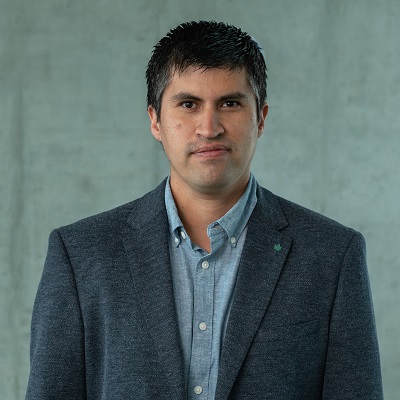
Jaime Villafaña Navea
Investigador Adjunto
Contacto

jaime.villafana@ucsc.cl

+56412345221
Jaime Villafaña Navea
Investigador Adjunto
Título Académico:
Biólogo Marino, Universidad Católica del Norte, Chile
Grado Académico:
Doctor en Ciencias Naturales, University of Vienna, Austria
Producción Científica
Proyectos
2025-2026. Proyecto “The guitarfish of the Atacama Desert”, Marine Conservation Action Fund, Acuario de New England, Estados Unidos. Colaborador cientifico.
2023-2026. FONDECYT postdoctoral,# 3230610 “Conservation paleobiology in Chile: using species distribution models to predict past, present and future suitable areas of marine fishes”, Universidad Austral de Chile, Valdivia, Chile. Investigador principal.
2023-2024. Proyecto R20F0008 “Programa de Investigación para la Planificación de la Acción del Clima (Climate Action Planning, CLAP)”, Centro Avanzado en Zonas Áridas (CEAZA), Coquimbo, Chile. Investigador joven.
2022. FONDECYT #200843: “A network-theory approach to understanding the paleobiogeographic dynamics of marine bivalves of the southeastern Pacific across the late Cenozoic”, Universidad Católica del Norte, Coquimbo, Chile. Asistente de investigación.
2020-2022. Proyecto “SHARKS-XT: Shark extinctions: from the past to the future”, Marie Curie Independent Fellowship (MSCA-IF-EF-ST) de Dra. Catalina Pimiento, University of Zurich, Suiza. Coordinador principal.
2014-2016. FONDECYT ## 1140841 “Species interactions in mollusk assemblages across geographic and evolutionary scales”, Centro de Estudios Avanzados en Zonas Áridas (CEAZA), Universidad Católica del Norte, Coquimbo, Chile. Asistente de investigación.
2012-2014. INACH G_05-11. “Bergmann’s and Cope’s rules and the Evolutionary Dwarfism in Antarctic and Magellan Mollusks, Coquimbo, Chile. Asistente de investigación.
2011-2013. FONDECYT # 1110582, “Evolutionary determinants of the latitudinal gradients of biodiversity of rocky intertidal gastropods”, Centro de Estudios Avanzados en Zonas Áridas (CEAZA), Universidad Católica del Norte, Coquimbo, Chile. Asistente de investigación.
2010-2011. FONDECYT #1100749 “The ecology of floating macroalgae: persistence of kelp rafts at the sea surface under natural conditions”, Centro de Estudios Avanzados en Zonas Áridas (CEAZA), Universidad Católica del Norte, Coquimbo, Chile. Asistente de investigación.
2010. FONDECYT # 11070147 “The structure and dynamics of mollusk assemblages during the late Quaternary in northern Chile: an historical approach to evaluate the human impacts on coastal marine biodiversity”, Universidad Católica del Norte, Coquimbo, Chile. Asistente de investigación.
Publicaciones
Todas las publicaciones están indexadas en WoS (Core Collection: Science Citation Index Expanded), salvo que se indique otra indexación.
Gardiner, A., Mathes, G., Cooper, R., Kocákova, K., Villafaña, J. A., Silvestro, D., Pimiento, C. (2026). Revealing the hidden patterns of sharks and ray diversity over the past 145 million years. Current Biology 36(3): 1-9. https://doi.org/10.1016/j.cub.2025.12.017
Villafaña, J. A., Campos-Medina, J., Chávez-Hoffmeiser, M., Araya, S., Araya, B., Ledezma, L., Hernandez, Y., Ramos, H., Bolomey, J., Tejo, M., Vera, F., Campoy, A., Arotaipe, R., Bugueño, Y., Antiquera, B., Rivadeneira, M. (2025). Diving into the past: A new assemblage of Neogene elasmobranch microfossils from the eastern Pacific of South America. Papers in Palaeontology. https://doi.org/10.1002/spp2.70043
Kocákova, K., Silvestro, D., Mathes, G., Villafaña, J. A., Pimiento, C. (2025). New global extinction events and persistent age-dependency in sharks and rays. Proceedings of the Royal Society B, 292 (2061). https://doi.org/10.1098/rspb.2025.2272
Oyanadel-Urbina, P., Villafaña, J. A., Campos-Medina, J., Buldrini, K., Ramos, H., Hernandez, Y., Rivadeneira, M. (2025) What do we know about Neogene bony fishes from Chile? Diversity and biogeographic implications. Palaeontologia electronica, 28(2):a30. https://doi.org/10.26879/1385
Cañete-Cañete, N., Villafaña, J. A., Farias, L., Gayo, E., Rivadeneira, M. (2025) The fossil record of chondrichthyans from the Cretaceous-Eocene in Chile: diversity and paleobiogeographic implications. Historical biology, 1-19. https://doi.org/10.1080/08912963.2025.2530141
Almendras, D., Villafaña, J. A., Rivadeneira. (2025) The Juan Fernandez wrasse Malapterus reticulatus in the continental shelf of Chile. Austral Ecology. Co-autor. https://doi.org/10.1111/aec.70027
Almendras, D., Villafaña, J. A., Bustamante, C., Contreras, I., Campoy, A., Duffloq, P., Rivadeneira, M. (2025) New evidence confirms the presence of the Diamond Stingray Hypanus dipterurus (Jordan & Gilbert 1880) in Chile and extends its southern range. Journal of fish biology, 1-6. https://doi.org/10.1111/jfb.16039
Pimiento, C., Kocáková, K., Mathes, G. H., Argyriou, T., Cadena, E.-A., Cooper, J. A., Cortés, D., Field, D. J., Klug, C., Scheyer, T. M., Valenzuela-Toro, A. M., Buess, T., Günter, M., Gardiner, A. M., Hatt, P., Holdener, G., Jacober, G., Kobelt, S., Masseraz, S., Mehli, I., Reiff, S., Rigendinger, E., Ruckstuhl, M., Schneider, S., Seige, C., Senn, N., Staccoli, V., Baumann, J., Flüeler, L., Guevara, L. J., Ickin, E., Kissling, K. C., Rogenmoser, J., Spitznagel, D., Villafaña, J. A., Zanatta, C. (2024). The extinct marine megafauna of the Phanerozoic. Cambridge Prisms: Extinction, 2, e7. https://doi.org/10.1017/ext.2024.12
Villafaña J. A., Chávez-Hoffmeister, M., Cumplid, N., Campos-Medina, J., Oyanadel-Urbina, P., Rivadeneira. M. M. (2023) The fossil distribution of two pelagic shark species (Alopias vulpinus and Lamna nasus) from South America. Historical Biology:1-9. https://doi.org/10.1080/08912963.2023.2259409
Dillon, E., Dunne, E., Womack, T., Kouvari, M., Larina, E., Claytor, J., Ivkić, A., Juhn, M., Milla-Carmona, P., Robson, S., Saha, A., Villafaña, J. A., Zill, M. E. (2023) Challenges and directions in analytical paleobiology. Paleobiology, 49(3): 1-17. https://doi.org/10.1017/pab.2023.3
Hoffmeister, M. C., Villafaña, J. A. (2023) The Neogene record of cartilaginous fishes (Chondrichthyes: Holocephali, Elasmobranchii) from northern Chile: A review and identification guide. Journal of South American Earth Sciences, 104230. https://doi.org/10.1016/j.jsames.2023.104230
Villafaña, J. A., Rivadeneira, M. M., Pimiento, C., and Kriwet, J. (2023) Diversification trajectories and paleobiogeography of Neogene chondrichthyans in Europe. Paleobiology, 1-13. https://doi.org/10.1017/pab.2022.40
Villafaña, J. A., Kindlimann, R., Chavez-Hoffmeister, M. (2022) The confirmed fossil record of the blue shark Prionace glauca (Linnaeus, 1758) from the South Eastern Pacific. Spanish Journal of Palaeontology, 37(2): 249-256. https://doi.org/10.7203/sjp.25576
Oyanadel-Urbina, P., De Gracia, C., Carrillo-Briceño, J. D., Nielsen, S., N., Flores, H., Casteletto, V., Kriwet, J., Rivadeneira, M., Villafaña, J. A. (2021) Neogene bony fishes from the Bahía Inglesa Formation, northern Chile. Ameghiniana 58(4): 345-368. https://doi.org/10.5710/AMGH.26.05.2021.3375
Guicharrouse-Vargas, M., Villafaña, J. A., Carrrillo-Briceño, J. D., Oyanadel-Urbina, P., Figueroa, R., Perez- Marin, J. P., Rivadeneira, M. M., Kriwet, J. (2021) The first fossil record of the sawshark Pliotrema (Pristiophoridae) from the Neogene of the South-eastern Pacific. Ameghiniana 58(2): 122-131. https://doi.org/10.5710/AMGH.01.03.2021.3389
Cawley, J., Marramá, G., Carnevale, G., Villafaña, J. A., Lopez Romero, F., Kriwet, J. (2021) The rise and fall of †Pycnodontiformes: Diversity, competition and extinction of a successful clade of neopterygian fishes in deep-time. Ecology and Evolution 1-28. https://doi.org/10.1002/ece3.7168
Villafaña, J. A., Hernandez, S., Alvarado, S., Shimada, K., Pimiento, C., Rivadeneira, M., Kriwet, J. (2020) First evidence of paleo-nursery area of the Great White Shark (Carcharodon carcharias) during the Pliocene. Scientific Reports 10:8502. https://doi.org/10.1038/s41598-020-65101-1
Villafaña, J. A., Marrama, G., Pollerspock, J., Balsberger, M., Rivadeneira, M. M., Kriwet, J. (2020) Shark, rays and skates (Chondrichthyes, Neoselachii) from the Upper Marine Molasse (Ottnangian, early Miocene) of Simssee area (Bavaria, Germany). PalZ. https://doi.org/10.1007/s12542-020-00518-7
Carrillo-Briceño, J., Villafaña, J. A., De Gracia, C., Flores-Alcívar F. F., Kindlimann, R., Abella, J. (2020) Diversity and paleoenvironmental implications of an elasmobranch assemblage from the Oligocene-Miocene boundary of Ecuador. PeerJ, 8:e9051. https://doi.org/10.7717/peerj.9051
Villafaña J. A., Marrama, G. Hernandez, S., Carrillo-Briceño, J., Hovestadt, D., Klindimann, D. Kriwet, J. (2019) The Neogene fossil record of Aetomylaeus (Elasmobranchii, Myliobatidae) from the south-eastern Pacific with comment on its dental variations. Journal of Vertebrate Paleontology: e1577251. https://doi.org/10.1080/02724634.2019.1577251
Villafaña, J. A., Nielsen, S. N., Klug, S., Kriwet, J. (2019) Early Miocene cartilaginous fishes (Chondrichthyes: Holocephali, Elasmbobranchii) from Chile: Palaebiogeographic and ecological implications. Journal of South American Earth Sciences, 96: 102317. https://doi.org/10.1016/j.jsames.2019.102317
Partarrieu, D., Villafaña, J. A., Pinto, L., Mourgues, A., Oyanadel, P., Rivadeneira, M. M., Carrillo-Briceño, J. (2018) Neogene “Horn sharks” Heterodontus (Chondrichthyes: Elasmobranchii) from the southeastern Pacific and their paleonenvironmental significance. Ameghiniana, 55(6): 651-667. https://doi.org/10.5710/AMGH.19.10.2018.3202
Villafaña, J. A., Rivadeneira, M.M. (2018) The modulating role of intrinsic factors on the biogeographic dynamics of chondrichthyans from the Neogene to the present. Paleobiology 44(2): 1-12. https://doi.org/10.1017/pab.2018.7
Staig, F., Hernandez, S., Lopez, P., Varas, C., Villafaña, J. A., Carrillo-Briceño. (2015) Late Neogene Elasmobranch fauna from the Coquimbo formation, Chile. Revista Brasileira de Paleontología, 18 (2): 261-272. https://doi.org/10.4072/rbp.2015.2.07
Rivadeneira, M. M, Alballay, A., Villafaña, J. A., Raimondi, P., Blanchette, C., Fenberg, P. (2015) Geographic patterns of diversification and the latitudinal gradient of richness of rocky intertidal gastropods: the ‘into the tropical museum’ hypothesis. Global Ecology and Biogeography, 24: 1149–1158. https://doi.org/10.1111/geb.12328
Villafaña, J. A., Rivadeneira, M. M. (2014) The rise and fall of the diversity of marine vertebrates during the Neogene on the Temperate Pacific coast of South America. Paleobiology: 40(4). WoS. https://doi.org/10.1666/13069
Cursos que dicta
Pregrado
- Bioestadística
- Ecología General
- Introducción a la Paleontología
- Métodos y análisis para evaluar el cambio climático en ambientes marinos
- Genetica y Evolución
Postgrado
- Unidad de Investigación
Estudios
Grados académicos
- Licenciado en Ciencias del Mar, Universidad Católica del Norte, Chile
- Magister en Ciencias del Mar, Universidad Catolica del Norte, Chile
- Doctor en Ciencias Naturales, University of Vienna, Austria
Título profesional
- Biologo Marino, Universidad Catolica del Norte, Chile
Líneas de investigación

Paleobiología de la conservación
Taxonomía, biogeografía y ecología de peces
Dinámicas macroevolutivas de vertebrados marinos
Paleobiología de la conservación
Taxonomía, biogeografía y ecología de peces
Dinámicas macroevolutivas de vertebrados marinos
Mi campo de especialización es el estudio de la historia evolutiva de los vertebrados marinos, con énfasis en los peces óseos y cartilaginosos. Mis lineas de investigación son la taxonomía, biogeografía, ecología y macroevolución de vertebrados marinos del pasado y reciente.
También estoy interesado en el modelamiento de la distribución geográfica de los organismos marinos del pasado y presente. Utilizo esta información para realizar proyecciones de la potencial distribución de especies que en la actualidad se encuentran en peligro de extinción o son de importancia comercial. Esto ultimo con la finalidad de evaluar el efecto del calentamiento global sobre la distribución de las especies en los próximos años.
